Speech, by Mariam Khalique, teacher of Pakistani school girl Malala Yousafzai, at an event in New York for the release of the Education For All Global Monitoring Report’s new analysis, Education Transforms.
“Bismillah! In the name of ALLAH, the most merciful, the most beneficent. Ladies and gentlemen, boys and girls – I feel honoured to be here today to be able to share my experiences with you.
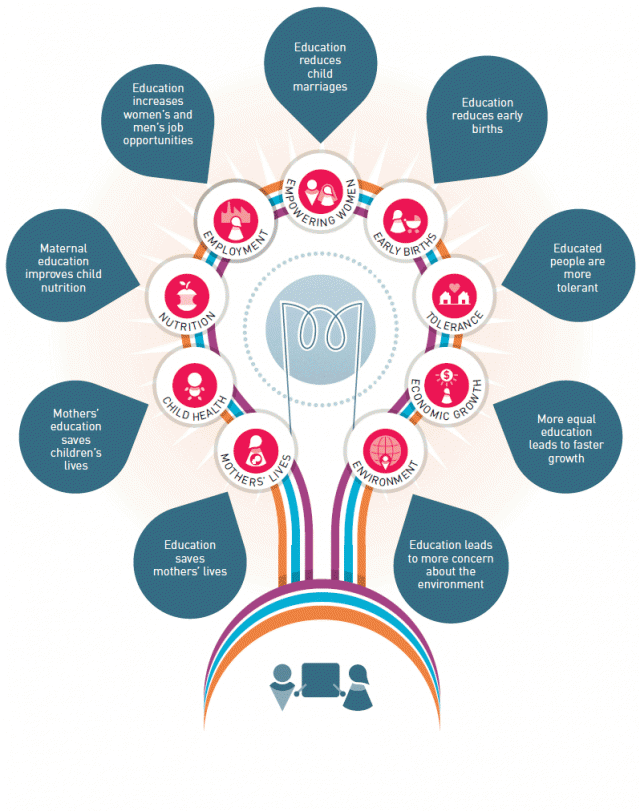
Before sharing with you my story and experiences, I want to introduce myself. My name is Mariam Khalique and I have been teaching at the Khushal School and College in the Swat Valley in Pakistan for over 11 years. During my time at the school I was Malala Yousafzai’s teacher for many years. Where I come from, most of the people don’t know the value of education. This is the situation even though as you have heard fromnew UNESCO research that education can save…
Education lights every stage of the journey to a better life, especially for the poor and the most vulnerable. Education’s unique power to act as a catalyst for wider development goals can only be fully realized, however, if it is equitable. That means making special efforts to ensure that all children and young people – regardless of their family income, where they live, their gender, their ethnicity, whether they are disabled – can benefit equally from its transformative power.
Education empowers girls and young women, in particular, by increasing their chances of getting jobs, staying healthy and participating fully in society – and it boosts their children’s chances of leading healthy lives.
To unlock the wider benefits of education, all children need the chance to complete not only primary school but also lower secondary school. And access to schooling is not enough on its own: education needs to be of good quality so that children actually learn. Given education’s transformative power, it needs to be a central part of any post-2015 global development framework.
The United Nations Girls’ Education Initiative (UNGEI) is a multi-stakeholder partnership committed to improving the quality and availability of girls’ education and contributing to the empowerment of girls and women through transformative education. It is founded on an understanding that all girls have the right to learn in a safe and supportive learning environment.
UNGEI, as a designated flagship of Education for All (EFA), strives to support governments and the international community to deliver on the gender-related EFA goals and education related Millennium Development Goals (MDGs). Our partners unite under the UNGEI umbrella with the belief that a collaborative advantage can be gained through collective efforts.
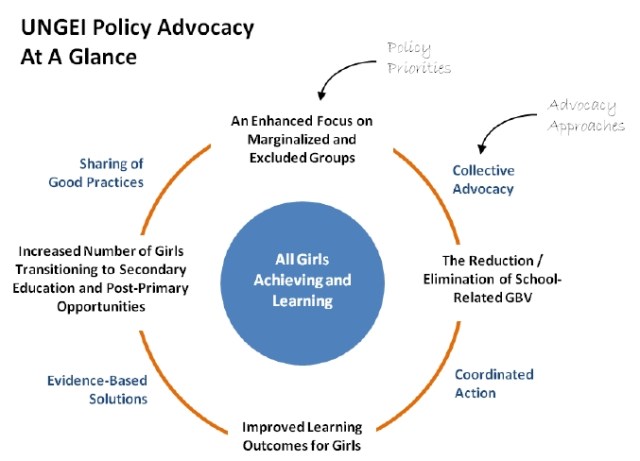
In order to maximize efforts which are the most needed and which will have the highest impact on girls’ education around the world, UNGEI is focusing policy advocacy efforts on four key strategic priorities which are outlined further in this document:
An enhanced focus on marginalized and excluded groups: “Evidence shows that disadvantage builds on disadvantage and gender gaps often widen among the poor and other marginalized groups.”
The reduction/elimination of school-related gender-based violence: “A safe space for all girls to learn and fulfill their potential is a fundamental human right. Anything less should never be accepted.”
Improved learning outcomes for girls: “Although overall learning outcomes are low across all groups in poor countries, there are disparities in learning outcomes according to gender, location and socio-economic status: poor, rural girls are the least likely to learn anything in school.”
An increased number of girls transitioning to secondary education and accessing post-primary opportunities: “UNGEI believes that post-primary schooling is critical for equipping girls with the knowledge, skills and attitudes necessary to transition to work or higher education, and to be healthy and productive citizens; hence access to post-primary opportunities and completion of secondary education should be a key ask for the post-2015 development agenda.”
In order to make progress on each of the four policy priority areas, UNGEI will primarily use the following advocacy approaches to influence decision-makers at the global, regional and country levels:
Collective Advocacy: UNGEI will participate at key global, regional and country level events to encourage political action, social mobilization and acceleration of support for girls’ education and gender equality.
Coordinated Action: UNGEI represents a diverse array of interests, from global development organizations and academic institutions to regional education bodies and local programs. UNGEI provides a platform that allows partners to connect with each other, reach out and form regional and country-based partnerships, and maximize educational benefits for girls and young women around the world.
Evidence-based Solutions: UNGEI will support the development and dissemination of research that will provide evidence needed to develop policy, allocate budgets, and implement programmes in a manner to support girls achieving and learning.
Sharing of Good Practice: UNGEI will act as a knowledge broker, providing partners and stakeholders with access to tools, good practices and experience, and allow for greater connectivity between individuals and organizations working in the field of girls’ education and gender equality.
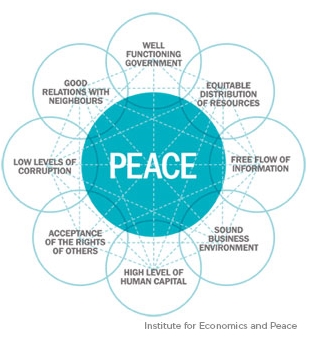
The Institute for Economics and Peacejust released its latest report, Pillars of Peace. It provides a new conceptual framework for understanding and describing the factors that are associated with peaceful societies. The research is based on an analysis of over 4,000 data sets, surveys and indices; it is the first empirical framework that aims to measure positive peace.
The research defines 8 key Pillars that underpin peace:
a well functioning government,
a sound business environment,
an equitable distribution of resources,
an acceptance of the rights of others,
good relations with neighbors,
free flow of information,
a high level of human capital,
low levels of corruption.
These pillars are both interdependent and mutually reinforcing, meaning that the relative strength of any one pillar has the potential to either positively or negatively influence peace. The full report is available here:
Measuring positive peace : Peace is not just the absence of violence, it is much more. Peace is best understood through the concepts of “positive peace” and “negative peace”. Negative peace is the absence of violence or the fear of violence; it is the definition of peace that is used in the Global Peace Index (GPI).Positive peace is the attitudes, institutions and structures, that when strengthened, lead to peaceful societies.
The Pillars of Peace has been developed to measure the positive peace factors that create peaceful societies. These same positive peace factors are positively associated with development outcomes, and the flourishing of human potential.
“There is one universal truth, applicable to all countries, cultures and communities: violence against women is never acceptable, never excusable, never tolerable.” – United Nations Secretary-General, Ban Ki-Moon (2008, SG/SM/11437 WOM/1665)
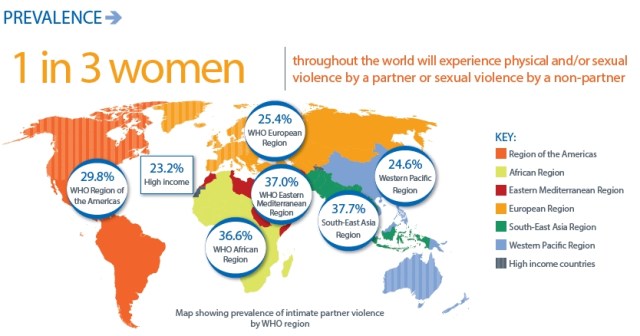
This report, developed by the World Health Organization, the London School of Hygiene and Tropical Medicine and the South African Medical Research Council presents the first global systematic review of scientific data on the prevalence of two forms of violence against women:violence by an intimate partner (intimate partner violence) and sexual violence by someone other than a partner (non-partner sexual violence). It shows, for the first time, global and regional estimates of the prevalence of these two forms of violence, using data from around the world. Previous reporting on violence against women has not differentiated between partner- and non-partner violence.
The report shows that violence against women is pervasive globally. The findings send a powerful message that violence against women is not a small problem that only occurs in some pockets of society, but rather is a global public health problem of epidemic proportions, requiring urgent action. It is time for the world to take action: a life free of violence is a basic human right, one that every woman, man and child deserves.
The report also details the effects of violence on women’s physical, sexual and reproductive, and mental health:
The variation in the prevalence of violence seen within and between communities, countries and regions, highlights that violence is not inevitable, and that it can be prevented:
“Promising prevention programmesexist, and need to be tested and scaled up. There is growing evidence about what factors explain the global variation documented. This evidence highlights the need to address the economic and sociocultural factors that foster a culture of violence against women. This also includes the importance of challenging social norms that support male authority and control over women and sanction or condone violence against women; reducing levels of childhood exposures to violence; reforming discriminatory family law; strengthening women’s economic and legal rights; and eliminating gender inequalities in access to formal wage employment and secondary education.”
To learn more, here is the access to the full report:
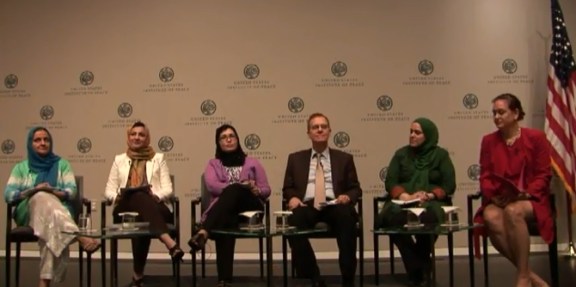
On July 18th, 2013, the U.S. Institute of Peaceand U.S. Agency for International development hosted an expert panel, which discussed efforts made by multilateral actors within the U.S. Government and internationally, in ensuring a commitment to the empowerment of women and girls in Afghanistan.
Research repeatedly shows that no nation can achieve sustainable peace, reconciliation, stability, and economic growth when half the population is marginalized. USAID and the U.S. Institute of Peace are fully committed to removing constraints on women’s potential — their contributions to Afghan society are imperative to lasting peace, stability and economic progress. This event took stock of progress thus far, of on-going commitments to the needs of women and girls, and explored the potential impact of new programming and partnerships beyond the political and security transitions in 2014.
This event coincided with the release of the USAID Request for Proposal,Promote, a five-year program for women’s empowerment in Afghanistan. Promote is targeting the education, promotion, and training of a new generation of Afghan women, aged 18-30. With the goal of increasing women’s contributions to Afghanistan’s development, Promote strengthens women’s rights groups, boosts female participation in the economy, increases the number of women in decision-making positions within the Afghan government, and helps women gain business and management skills.
Here are the details about this expert panel:
Welcome and Introductions: Jim Marshall, President, U.S. Institute of Peace
Keynote Speaker: Rajiv Shah, USAID Administrator
Followed by a panel moderated by Carla Koppell, Chief Strategy Officer, Former Senior Coordinator on Gender, USAID. The panel included: Kathleen Kuehnast, Director, Center for Gender & Peacebuilding, USIP William Byrd, Afghanistan Senior Expert, U.S. Institute of Peace Naheed Farid, Member of the Afghan Parliament Rangina Hamidi, Founder, Kandahar Treasure Palwasha Kakar, Director of Women’s Empowerment and Development Programs, The Asia Foundation Hossai Wardak, Afghanistan Visiting Expert, U.S. Institute of Peace
Domestic violence and sexual abuse are often called “women’s issues.” But in this TED talk, Jackson Katz points out that these are intrinsically men’s issues — and shows how these violent behaviors are tied to definitions of manhood. A call for us all — women and men — to call out unacceptable behavior and be leaders of change.
Jackson Katzasks a very important question that gets at the root of why sexual abuse, rape and domestic abuse remain a problem: What’s going on with men?
According to him, there are 10 things men can do to prevent gender violence:
Approach gender violence as a MEN’S issue involving men of all ages and socioeconomic, racial and ethnic backgrounds. View men not only as perpetrators or possible offenders, but as empowered bystanders who can confront abusive peers
If a brother, friend, classmate, or teammate is abusing his female partner — or is disrespectful or abusive to girls and women in general — don’t look the other way. If you feel comfortable doing so, try to talk to him about it. Urge him to seek help. Or if you don’t know what to do, consult a friend, a parent, a professor, or a counselor. DON’T REMAIN SILENT.
Have the courage to look inward. Question your own attitudes. Don’t be defensive when something you do or say ends up hurting someone else. Try hard to understand how your own attitudes and actions might inadvertently perpetuate sexism and violence, and work toward changing them.
If you suspect that a woman close to you is being abused or has been sexually assaulted, gently ask if you can help.
If you are emotionally, psychologically, physically, or sexually abusive to women, or have been in the past, seek professional help NOW.
Be an ally to women who are working to end all forms of gender violence. Support the work of campus-based women’s centers. Attend “Take Back the Night” rallies and other public events. Raise money for community-based rape crisis centers and battered women’s shelters. If you belong to a team or fraternity, or another student group, organize a fundraiser.
Recognize and speak out against homophobia and gay-bashing. Discrimination and violence against lesbians and gays are wrong in and of themselves. This abuse also has direct links to sexism (eg. the sexual orientation of men who speak out against sexism is often questioned, a conscious or unconscious strategy intended to silence them. This is a key reason few men do so).
Attend programs, take courses, watch films, and read articles and books about multicultural masculinities, gender inequality, and the root causes of gender violence. Educate yourself and others about how larger social forces affect the conflicts between individual men and women.
Don’t fund sexism. Refuse to purchase any magazine, rent any video, subscribe to any Web site, or buy any music that portrays girls or women in a sexually degrading or abusive manner. Protest sexism in the media.
Mentor and teach young boys about how to be men in ways that don’t involve degrading or abusing girls and women. Volunteer to work with gender violence prevention programs, including anti-sexist men’s programs. Lead by example.
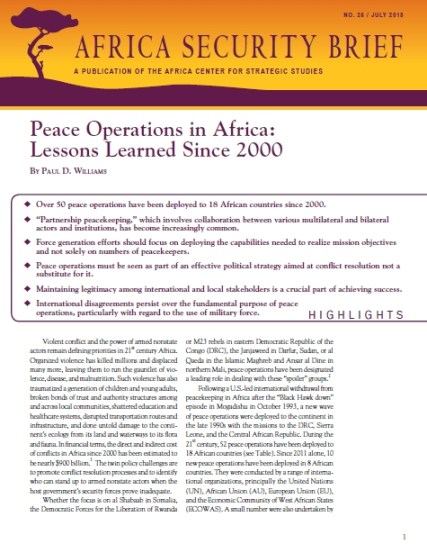
More than 50 peace operations have deployed in Africa since 2000, including multiple African-led or hybrid African Union/United Nations initiatives. The frequency of these deployments underscores the ongoing importance of these operations in the playbook of regional and multilateral bodies to prevent conflict, protect civilians, and enforce ceasefires and peace agreements. Recent operations have featured increasingly ambitious goals and complex institutional partnerships.
The achievements and shortcomings of recent peace operations offer vital lessons for optimizing this increasingly central but still evolving tool for addressing conflict and instability. This Africa Security Brief, authored by Paul D. Williams of George Washington University, takes stock of the numerous past missions and changes in mandates, expectations, and operations to flush out key policy considerations for current and future peace missions.
Highlights:
Over 50 peace operations have been deployed to 18 African countries since 2000.
“Partnership peacekeeping,” which involves collaboration between various multilateral and bilateral actors and institutions, has become increasingly common.
Force generation effortsshould focus on deploying the capabilities needed to realize mission objectives and not solely on numbers of peacekeepers.
Peace operations must be seen as part of an effective political strategy aimed at conflict resolution not a substitute for it
Maintaining legitimacy among international and local stakeholders is a crucial part of achieving success.
International disagreements persist over the fundamental purpose of peace operations, particularly with regard to the use of military force.
Key lessons:
An effective political strategy is a prerequisite for success.
Strategic coordination is crucial
Ends and means must be in synch
Define and deliver “robust” operations
Generate specific mission capabilities not just numbers of personnel
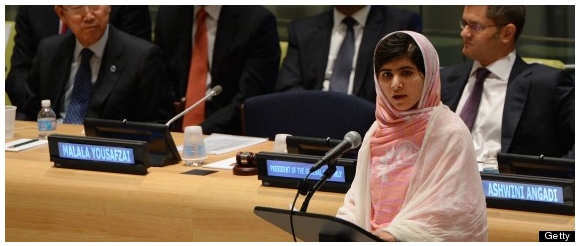
Malala Yousafzai marked her 16th birthday, on Friday, 12 July 2013 at the UnitedNations, by giving her first high-level public appearance and statement on the importance of education. Malala became a public figure when she was shot by the Taliban while travelling to school in October 2012 in Pakistan — targeted because of her committed campaigning for the right of all girls to an education. Flown to the United Kingdom to recover, she is now back at school and continues to advocate for every child’s right to education.
While you can find the video and full text of her speech below, here are some inspiring quotes:
“Let us pick up our books and our pens. They are our most powerful weapons. One child, one teacher, one pen and one book can change the world. Education is the only solution. Education First.”
“‘Malala Day’ is not my day. Today is the day of every woman, every boy and every girl who have raised their voice for their rights.”
“I want education for the sons and daughters of all the Taliban and all the terrorists and extremists. I do not even hate the Talib who shot me. Even if there is a gun in my hands and he stands in front of me. I would not shoot him.”
“We cannot all succeed when half of us are held back.”
In support of the UN Secretary-General’s Global Education First Initiative (GEFI), on 12 July – declared as “Malala Day” — the President of the UN General Assembly and the UN Special Envoy for Global Education with the support of A World at School initiative are organizing the UN Youth Assembly, where more than 500 young leaders from around the world will convene to accelerate the goal of getting all children, especially girls, in school and learning by 2015.
UNESCOand Save the Childrenreleased a special report ahead of Malala’s speech which found that 95% of the 28.5 million children who are not getting a primary school education live in low and lower-middle income countries: 44% in sub-Saharan Africa, 19% in south and west Asia and 14% in the Arab states.
Girls make up 55% of the total and are often the victims of rape and other sexual violence that accompanies armed conflicts.
Full text of Malala’s speech at the UN, July 12, 2013:
In the name of God, The Most Beneficent, The Most Merciful. Honourable UN Secretary General Mr Ban Ki-moon, Respected President General Assembly Vuk Jeremic Honourable UN envoy for Global Education Mr Gordon Brown, Respected elders and my dear brothers and sisters;
Today, it is an honour for me to be speaking again after a long time. Being here with such honourable people is a great moment in my life. I don’t know where to begin my speech. I don’t know what people would be expecting me to say. But first of all, thank you to God for whom we all are equal and thank you to every person who has prayed for my fast recovery and a new life. I cannot believe how much love people have shown me. I have received thousands of good wish cards and gifts from all over the world. Thank you to all of them. Thank you to the children whose innocent words encouraged me. Thank you to my elders whose prayers strengthened me. I would like to thank my nurses, doctors and all of the staff of the hospitals in Pakistan and the UK and the UAE government who have helped me get better and recover my strength. I fully support Mr Ban Ki-moon the Secretary-General in his Global Education First Initiative and the work of the UN Special Envoy Mr Gordon Brown. And I thank them both for the leadership they continue to give. They continue to inspire all of us to action. Dear brothers and sisters, do remember one thing. Malala day is not my day. Today is the day of every woman, every boy and every girl who have raised their voice for their rights. There are hundreds of human rights activists and social workers who are not only speaking for human rights, but who are struggling to achieve their goals of education, peace and equality. Thousands of people have been killed by the terrorists and millions have been injured. I am just one of them. So here I stand… one girl among many. I speak – not for myself, but for all girls and boys. I raise up my voice – not so that I can shout, but so that those without a voice can be heard. Those who have fought for their rights: Their right to live in peace. Their right to be treated with dignity. Their right to equality of opportunity. Their right to be educated. Dear Friends, on the 9th of October 2012, the Taliban shot me on the left side of my forehead. They shot my friends too. They thought that the bullets would silence us. But they failed. And then, out of that silence came, thousands of voices. The terrorists thought that they would change our aims and stop our ambitions but nothing changed in my life except this: Weakness, fear and hopelessness died. Strength, power and courage was born. I am the same Malala. My ambitions are the same. My hopes are the same. My dreams are the same. Dear sisters and brothers, I am not against anyone. Neither am I here to speak in terms of personal revenge against the Taliban or any other terrorists group. I am here to speak up for the right of education of every child. I want education for the sons and the daughters of all the extremists especially the Taliban. I do not even hate the Talib who shot me. Even if there is a gun in my hand and he stands in front of me. I would not shoot him. This is the compassion that I have learnt from Muhammad-the prophet of mercy, Jesus Christ and Lord Buddha. This is the legacy of change that I have inherited from Martin Luther King, Nelson Mandela and Muhammad Ali Jinnah. This is the philosophy of non-violence that I have learnt from Gandhi Jee, Bacha Khan and Mother Teresa. And this is the forgiveness that I have learnt from my mother and father. This is what my soul is telling me, be peaceful and love everyone. Dear sisters and brothers, we realise the importance of light when we see darkness. We realise the importance of our voice when we are silenced. In the same way, when we were in Swat, the north of Pakistan, we realised the importance of pens and books when we saw the guns. The wise saying, “The pen is mightier than sword” was true. The extremists are afraid of books and pens. The power of education frightens them. They are afraid of women. The power of the voice of women frightens them. And that is why they killed 14 innocent medical students in the recent attack in Quetta. And that is why they killed many female teachers and polio workers in Khyber Pakhtunkhwa and FATA. That is why they are blasting schools every day. Because they were and they are afraid of change, afraid of the equality that we will bring into our society. I remember that there was a boy in our school who was asked by a journalist, “Why are the Taliban against education?” He answered very simply. By pointing to his book he said, “A Talib doesn’t know what is written inside this book.” They think that God is a tiny, little conservative being who would send girls to the hell just because of going to school. The terrorists are misusing the name of Islam and Pashtun society for their own personal benefits. Pakistan is peace-loving democratic country. Pashtuns want education for their daughters and sons. And Islam is a religion of peace, humanity and brotherhood. Islam says that it is not only each child’s right to get education, rather it is their duty and responsibility. Honourable Secretary General, peace is necessary for education. In many parts of the world especially Pakistan and Afghanistan; terrorism, wars and conflicts stop children to go to their schools. We are really tired of these wars. Women and children are suffering in many parts of the world in many ways. In India, innocent and poor children are victims of child labour. Many schools have been destroyed in Nigeria. People in Afghanistan have been affected by the hurdles of extremism for decades. Young girls have to do domestic child labour and are forced to get married at early age. Poverty, ignorance, injustice, racism and the deprivation of basic rights are the main problems faced by both men and women. Dear fellows, today I am focusing on women’s rights and girls’ education because they are suffering the most. There was a time when women social activists asked men to stand up for their rights. But, this time, we will do it by ourselves. I am not telling men to step away from speaking for women’s rights rather I am focusing on women to be independent to fight for themselves. Dear sisters and brothers, now it’s time to speak up. So today, we call upon the world leaders to change their strategic policies in favour of peace and prosperity. We call upon the world leaders that all the peace deals must protect women and children’s rights. A deal that goes against the dignity of women and their rights is unacceptable. We call upon all governments to ensure free compulsory education for every child all over the world. We call upon all governments to fight against terrorism and violence, to protect children from brutality and harm. We call upon the developed nations to support the expansion of educational opportunities for girls in the developing world. We call upon all communities to be tolerant – to reject prejudice based on cast, creed, sect, religion or gender. To ensure freedom and equality for women so that they can flourish. We cannot all succeed when half of us are held back.We call upon our sisters around the world to be brave – to embrace the strength within themselves and realise their full potential. Dear brothers and sisters, we want schools and education for every child’s bright future. We will continue our journey to our destination of peace and education for everyone. No one can stop us. We will speak for our rights and we will bring change through our voice. We must believe in the power and the strength of our words. Our words can change the world. Because we are all together, united for the cause of education. And if we want to achieve our goal, then let us empower ourselves with the weapon of knowledge and let us shield ourselves with unity and togetherness. Dear brothers and sisters, we must not forget that millions of people are suffering from poverty, injustice and ignorance. We must not forget that millions of children are out of schools. We must not forget that our sisters and brothers are waiting for a bright peaceful future. So let us wage a global struggle against illiteracy, poverty and terrorism and let us pick up our books and pens. They are our most powerful weapons. One child, one teacher, one pen and one book can change the world. Education is the only solution. Education First.
The Office has secured political and diplomatic engagement of Member States on the protection of conflict-affected children through the submission of reports to the General Assembly and the Human Rights Council and by assisting in the preparation of the Secretary-General’s annual and country-specific reports on children and armed conflict to keep the Security Council appraised of developments on the ground.
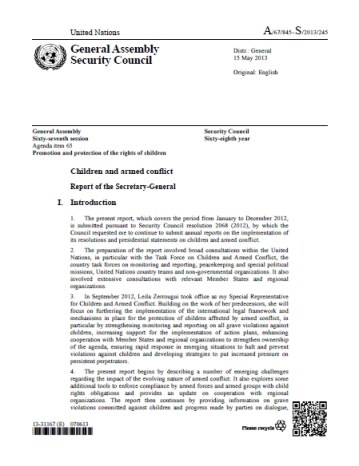
The 2012 annual reporton Children and Armed Conflict presents information about grave violations committed against children in 22 country situations, it notably:
describes a number of emerging challenges regarding the impact of the evolving nature of armed conflict;
explores additional tools to enforce compliance by armed forces and armed groups with child rights obligations;
provides an update on cooperation with regional organizations;
provides information on grave violations committed against children and progress made by parties on dialogue action plans and other measures to halt and prevent such grave violations;
and concludes with a series of recommendations to the Security Council.
The report also includes what is known as the “List of shame”: this is the list of armed groups and armed forces who recruit and use children, kill and maim, commit sexual violence or attacks on schools and hospitals in conflict zones.




 Tina Robiolle, PhD