U.N. Security Council new resolution on conflict-related sexual violence

The United Nations Security Council unanimously adopted a new resolution on conflict-related sexual violence on June 24, 2013.

ScreenShot014

Here is a statement by Lakshmi Puri, Acting Head of UN Women:

“UN Women welcomes the unanimous adoption of Security Council resolution 2106 (2013) on 24 June, the sixth resolution on Women, Peace and Security, and the fourth one focused on conflict-related sexual violence. This resolution, which adds greater operational detail to previous resolutions on this topic, reiterates that all actors, including not only the Security Council and parties to armed conflict, but all Member States and United Nations entities, must do more to implement previous mandates and combat impunity for these crimes.

UN Women is particularly encouraged that Resolution 2106, co-sponsored and supported by several dozen countries, affirms the centrality of gender equality and women’s political, social, and economic empowerment to efforts to prevent sexual violence in armed conflict and post-conflict situations. It also emphasizes the importance of implementing the full range of commitments emanating from resolution 1325, and recognizes UN Women’s efforts in this area. We applaud the efforts of the Special Representative of the Secretary-General on Sexual Violence, Ms. Zainab Bangura, the members of UN Action against Sexual Violence in Conflict, and the Security Council, led by the United Kingdom.”

ScreenShot013

Source: UN Women

Posted in Conflict Management, Gender Based Violence, Peace, Peacebuilding, Women | Tagged , , , , , , , , , , | Leave a comment

USAID Findings: Evidence in Youth Education in Crisis and Conflict

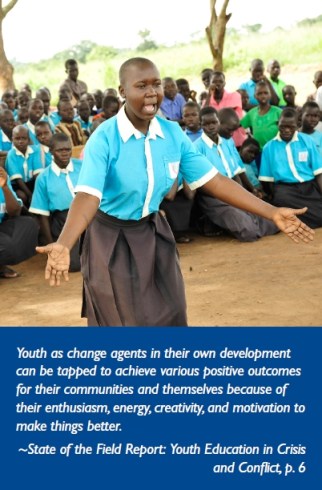
USAID just released its  latest research regarding international youth and education programming.

Cross-posting from USAID:

“Three new “State of the Field” reports summarize the findings of 122 unique studies and consultations with over 75 subject matter experts across three topics of investigation:

This research helps answer the question “What works in youth programming?” and informs practitioners and donors of important gaps in youth program evidence. Findings will help USAID shape a research and evaluation agenda for its youth and education programs, ultimately with the aim to increase development impact among and by the world’s one billion youth.”

Download the summary briefs:

ScreenShot015

Source: USAID

Posted in Child Protection, Conflict Management, Education, Fragile States, Girls' Education, International Development, Peacebuilding | Tagged , , , , , , , , , , | Leave a comment

Working to end gender-based violence at school: new report

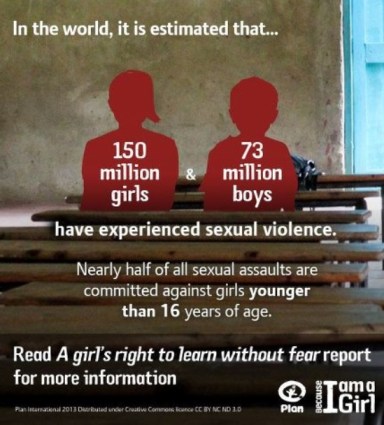
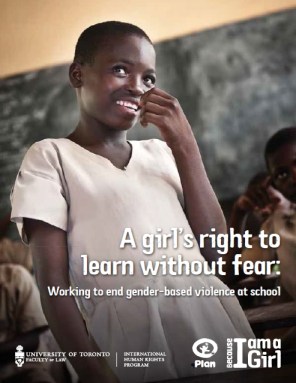
Worldwide, 66 million girls are missing out on an education. This new Plan International report, A girl’s right to learn without fear,  focuses on one of the major barriers girls face: gender-based violence – sexual, physical and psychological –in and around schools.

Between 500 million and 1.5 billion children experience violence every year, many within school walls. Girls are especially vulnerable to rape, exploitation, coercion and discrimination perpetrated by students and teachers.

ScreenShot028

A girl’s right to learn without fear looks at the issues and presents solutions which are drawn from existing policy examples, as well as global civil society campaigns, international instruments and the voices of girls themselves.

Plan calls on governments to prioritise actions tied to 8 key principles to ensure that all children can learn free from violence, and that girls benefit from their equal right to education.

1. Comprehensive and integrated action: Governments must adopt a comprehensive, integrated and multi-sectoral action plan to prevent and respond to violence. The plan should be genderresponsive, take into account the diversity of experiences and needs of marginalised girls and boys, and look specifically at the school context.

2. Effective legislation and regulation: Laws must explicitly protect children from violence, ensure accountability, and treat all children equally.

3. Safe and effective reporting and response: Reporting and response mechanisms must be clear, proportionate and consistent with the UN Convention on the Rights of the Child.

4. Evidence-based policy: Policy interventions must be supported by sufficient and credible data on the nature and scope of SRGBV.

5. Well-supported, well-trained personnel: Teachers and school administrators must be well-trained, equipped and supported to prevent and respond to gender-based violence in and around schools.

6. Partnership: Law enforcement, the judiciary, child protection authorities, the transportation sector and civil society organisations must be partners in addressing the vulnerability of children en route to and from school grounds.

7. Inclusiveness: Whole communities, including men and boys, must be involved to change harmful attitudes and shift social norms. Emphasis should be placed on issues of sexual health and sexual rights.

8. Participation: Girls and boys must be recognised as key participants in developing solutions to address SRGBV.

ScreenShot029

Download summary PDF : English | French | Spanish (2.6 Mb, 8 pages)

Download Full PDF : English | French (3.2 Mb, 64 pages)

Source: Plan International

Posted in Child Protection, Education, Fragile States, Gender Based Violence, Girls' Education, Human Rights, Human Rights Education, International Development, Peace Education, Women | Tagged , , , , , , , , , , , , , , , , | Leave a comment

Girls’ Leadership Development In Action: CARE’s experience from the field

CARE recently published “Girls’ Leadership Development in Action” as a follow-on to the 2009 edition called, “The Power to Lead: A Leadership Model for Adolescent Girls” which outlined CARE’s approach to leadership development and the prioritization of girls. In this document, you will see the results of research and programming in twenty eight countries across the globe from Honduras to Mali and Malawi to Cambodia, where CARE is implementing a comprehensive approach to education focused not only on providing girls with access to quality and equitable education, but also emphasizes leadership skills development.

A key finding from CARE’s evaluations is that in order for adolescent girls to capitalize on their education, it is critical to equip them with the skills and support that will enable them to:

  • express their opinions and ideas,
  • take action individually and collectively on issues of  personal importance, make healthy decisions,
  • and work toward future dreams and goals.

The document highlights key successes, critical lessons learned and important considerations for development practitioners as they design and implement girls’ education and leadership development interventions. This evidence supports the theory that education is the foundation of girls’ empowerment, but we must address the social structures around girls in order to enable them to realize their full potential.

The full report is available here:

ScreenShot018

Source: INEE

Posted in Child Protection, Education, Fragile States, Girls' Education, Human Rights, International Development, Peace, Peacebuilding, Women | Tagged , , , , , , , , , , , , | Leave a comment

One Billion Rising today: Ending Violence Against Women

A film by Eve Ensler and Tony Stroebel
One billion women violated is an atrocity. One billion women – and men — dancing is a revolution. More information at http://www.onebillionrising.org

ONE IN THREE WOMEN ON THE PLANET WILL BE RAPED OR BEATEN IN HER LIFETIME.*

On V-Day’s 15th Anniversary, 14 February 2013, ONE BILLION women and those who love them are invited to WALK OUT, DANCE, RISE UP, and DEMAND an end to this violence. ONE BILLION RISING will move the earth, activating women and men across every country. V-Day wants the world to see our collective strength, our numbers, our solidarity across borders.

ScreenShot017

ONE BILLION RISING IS:

  • A global strike
  • A call to men and women to refuse to participate in the status quo until rape and rape culture ends
  • An act of solidarity, demonstrating to women the commonality of their struggles and their power in numbers
  • A refusal to accept violence against women and girls as a given
  • A new time and a new way of being

Eve Ensler is a playwright and activist and the founder of V-Day, a global movement to end violence against women and girls.

Interview with Christine Amanpour.

Her newest work, I am an emotional creature: The Secret Life of Girls Around the World, was recently published by Random House in the U.S. For V-Day events near you, see http://www.vday.org/home

*2003 UNIFEM report entitled “Not A Minute More: Ending Violence Against Women,” or 2008, the UNITE To End Violence Against Women Campaign, initiated by UN Secretary-General’s Office

Posted in Gender Based Violence, Peace, Women | Tagged , , , , , , , , , , , | Leave a comment

Wartime Sexual Violence: new USIP report

This new USIP (United States Institute of Peace) report summarizes ten major misconceptions about wartime sexual violence, highlighting both advances and gaps in our knowledge. Drawing on social science research, it outlines for policymakers the current state of knowledge about wartime sexual violence, details gaps in existing knowledge, and explores the implications of these findings for policymaking.

Summary:

  • Wartime rape is neither ubiquitous nor inevitable. The level of sexual violence differs significantly across countries, conflicts, and particularly armed groups. Some armed groups can and do prohibit sexual violence. Such variation suggests that policy interventions should also be focused on armed groups, and that commanders in effective control of their troops are legally liable for patterns of sexual violence they fail or refuse to prevent.
  • Wartime rape is also not specific to certain types of conflicts or to geographic regions. It occurs in ethnic and non-ethnic wars, in Africa and elsewhere.
  • State forces are more likely to be reported as perpetrators of sexual violence than rebels. States may also be more susceptible than rebels to naming and shaming campaigns around sexual violence.
  • Perpetrators and victims may not be who we expect them to be. During many conflicts, those who perpetrate sexual violence are often not armed actors but civilians. Perpetrators also are not exclusively male, nor are victims exclusively female. Policymakers should not neglect nonstereotypical perpetrators and victims.
  • Wartime rape need not be ordered to occur on a massive scale. Wartime rape is often not an intentional strategy of war: it is more frequently tolerated than ordered. Nonetheless, as noted, commanders in effective control of their troops are legally liable for sexual violence perpetrated by those troops.
  • Much remains unknown about the patterns and causes of wartime sexual violence. In particular, existing data cannot determine conclusively whether wartime sexual violence on a global level is increasing, decreasing, or holding steady. Policymakers should instead focus on variation at lower levels of aggregation, and especially across armed groups.

The report is available here.

USIP

Source: USIP

Posted in Child Protection, Gender Based Violence, Peacebuilding, Women | Tagged , , , , , , , | Leave a comment

A Path to Dignity: The Power of Human Rights Education

A Path to Dignity: The Power of Human Rights Education is a 28-minute movie that presents three stories illustrating the impact of human rights education respectively on school children (India), law enforcement agencies (Australia) and women victims of violence (Turkey).

Human Rights Education Associates (HREA), Soka Gakkai International (SGI) and the Office of the United Nations High Commissioner for Human Rights (OHCHR) have jointly produced this film as a tool to raise awareness about the positive role that human rights education can play in fulfilling human rights.

A key message is that “one person can make a difference” in solving problems in society. Human rights education can transform people’s lives, empowering individuals on a path to dignity and bring about positive change in their respective communities and societies. In this sense, human rights education plays a fundamental role in ensuring equality and equal opportunities, combating discrimination and preventing human rights violations.

The film also shows the significance of United Nations instruments and frameworks ‒ such as the World Programme for Human Rights Education (2005 – ongoing) in advancing implementation of human rights education. A Path to Dignity includes statements by the United Nations High Commissioner for Human Rights and the President of Costa Rica, a country which has been playing a crucial role for human rights education in the United Nations context.

HREA, SGI and OHCHR started production of the film in 2010 in anticipation of the United Nations Declaration on Human Rights Education and Training, which was adopted by the General Assembly on 19 December 2011.

A Path to Dignity is available in Arabic, Chinese, English, French, Japanese, Russian and Spanish. For More information, please visit the “A Path to Dignity” Website.

The Carr Center for Human Rights Policy will organize an event at Harvard Kennedy School of Government around this movie on Friday, February 22, 2013, from 12:00 – 1:30 pm at the (in room Taubman 275). For more information about this event, please click here.

Path to Dignity

Posted in Child Protection, Education, Fragile States, Girls' Education, Human Rights, Human Rights Education, Peace, Peace Education, Peacebuilding, Women | Tagged , , , , , , , , , , , , , , , , , , , , , | Leave a comment

New report: Impact of Economic Crisis on Girls and Young Women

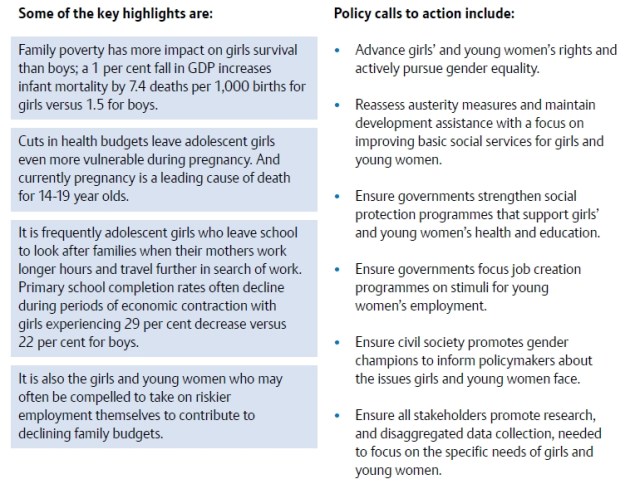
This 2013 report by Plan International and ODI examines the continuing and deepening impact economic crisis is having on girls and young women worldwide. Long standing economic trends, entrenched gender inequality and austerity budgets have all left girls and their families bearing the brunt of fewer resources and reduced access to services.

The full report is available here:

Impact of the economic crisis on girls and young women

The report key findings include:

  • Girls drop out of school more – with a 29% decrease in primary school completion for girls versus 22% for boys.
  • Family poverty hits girls hardest – a 1% fall in GDP increases infant mortality by 7.4 deaths per 1,000 births for girls versus 1.5 for boys.
  • Health cuts leave adolescent girls at greater risk during pregnancy with 14-19 year olds most at risk of death in pregnancy in many countries.

ScreenShot017

Source: Plan International

Posted in Child Protection, Education, Fragile States, International Development, Women | Tagged , , , , , , , , , , , | Leave a comment

UNICEF’s Humanitarian Action for Children 2013 Report

UNICEF’s Humanitarian Action for Children 2013 highlights the humanitarian situation faced by millions of children and women and the support required to help their families, communities and national institutions meet their basic needs, promote their well-being and provide them with protection. 

Cross-posted from UNICEF

UNICEF is appealing for almost US$1.4 billion to assist millions of children, women and men by providing them with nutritional support, health care, water, sanitation, learning spaces and materials, protection services, shelter and information. This support is not only to provide lifesaving emergency interventions, but also to strengthen national preparedness systems and build resilience at community, subregional and national levels, so that avoidable illnesses and deaths are prevented and those affected are able to recover. In partnership with national governments, civil society organizations and other United Nations agencies, UNICEF works in some of the most challenging environments in the world to deliver results for millions of children and women threatened by natural disasters or complex emergencies. Despite challenges and constraints, sustained advocacy, political and financial commitment, and collaboration in 2012 resulted in achievements that need to be built upon and continued into 2013.

UNICEF's Humanitarian Action for Children 2013 Report

The past year saw the combined and cumulative effects of armed conflict, civil and political unrest, erratic and severe weather patterns, seismic activity, disease outbreaks and the global economic crisis lead to the death, illness, deprivation, displacement anddistress of a significant number of children, women and men across the globe.

The same factors caused the destruction or further degradation of homes, hospitals, schools, roads and other public and social infrastructure, services and networks, preventing millions of children from receiving treatment for illness, drinking safe water, going to school or even playing. Some children were separated from their primary caregivers, while others fled, unaccompanied, to safer locations. Meanwhile many others were recruited by armed groups as soldiers and labourers. Whether affected by disasters or conflict, they suffered psychological and social distress in addition to physical suffering and harm. All too often, these new disasters and conflicts occurred in areas already battered by successive economic, climatic,political and other security shocks, severely compromising the ability of caregivers to feed and protect their children, and fulfil their basic needs.

In order to prevent, address or overcome some of the consequences of these natural and human-made disasters in 2012, UNICEF initially appealed for US$1,284,358,000. During the course of the year, as new crises occurred and ongoing situations deteriorated or improved, the overall requirements were revised, and by the end of October had increased by 14 per cent to US$1,472,172,823. As of 31 October, US$664,475,807, or 45 per cent of the required funds, had been mobilized. In addition, UNICEF received US$19,573,247 from the Central Emergency Response Fund (CERF) and other funding sources to address the unforeseen needs for countries that were not part of the Humanitarian Action for Children 2012, appeal, bringing the total of funding mobilized to US$684,049,044.

Source: UNICEF

Posted in Child Protection, Education, Fragile States, Girls' Education, Human Rights, International Development | Tagged , , , , , , , , , | Leave a comment

Life skills taught in school vital to reduce risk of HIV and AIDS

World Education Blog

Only 7% of school children in E & S Africa have desired level of knowledge on HIV and AIDS

On World AIDS Day, new research conducted for the Global Monitoring Report  ‘Youth and Skills: Putting education to work’ shows the importance of investing in life skills education in school to ensure children have the confidence and negotiating skills to say no to sex and negotiate condom use.  Tests with around 60,000 grade 6 students in fourteen countries in South and East Africa showed that only 7% of school children in the regions have the desired level of knowledge on HIV and AIDS; and just 36% have even the minimum level of knowledge.

In twelve of the fourteen countries assessed in the regions, children from poorer households and those in rural areas scored significantly lower than those of high socio-economic status. In South Africa for example, one of the countries with the…

View original post 500 more words

Posted in Child Protection, Education, Gender Based Violence, Girls' Education, International Development, Peace Education | Leave a comment